10 December 2012

Twenty Five ways with scarves - essential winter-time wear: http://www.amandapearl.com/blog/?p=6262


... and here's another one ... 50 ways to tie a scarf:
http://www.scarves.net/blog/how-to-tie-scarves/


http://pinterest.com/myfashionpins/scarves/

6 December 2012


With lots of stuff to sort and declutter I sought inspiration on the internet and found this little gem:

1. Give yourself five minutes at a time:  Then if you're enjoying yourself extend the time, but not so much that you get fed up or bored.  This is the way I garden too, snatching odd moments - and enjoying being outdoors.
2. Give away one item each day. That's 365 things a year!  Charity shops will be pleased of your input, and so would freecycle.
3. Fill one plastic bag. One of my favorite decluttering techniques is to grab a single bag and see how quickly I can fill it. While much of what I collect is rubbish, this could also be used to fill a bag for a charity shop.

http://www.slowyourhome.com/2012/11/22/amazingly-awesome/
4. Try the clothes hanger experiment. To identify wardrobe pieces to clear out, hang all your clothes with the hangers in the reverse direction. After you wear an item, return it to the wardrobe with the hanger facing the correct direction. After a few months, you’ll have a clear picture of which clothes you can easily discard. 
5. Make a list. Create a list of areas to declutter, beginning with the easiest.
6. Take the 12-12-12 Challenge. A simple task of locating 12 items to throw away, 12 items to donate, and 12 items to be returned to their proper home can be a really fun and exciting way to quickly organize 36 things in your house.
7. Change your perspective. Look at your home from the view of a visitor or prospective house purchaser.
8. Experiment with numbers. For example, project 333 is a challenge to wear 33 articles of clothing for 3 months as a way of challenging yourself to live with less.
9. Use your imagination. As yourself questions like, “If I was just buying this now, how much would I pay?” Creative techniques such as this may prove to be very helpful for some with difficulties removing unneeded clutter.
10.The Four-Box Method. Leading on from the 12/12/12 challenge above.  When sorting have four boxes: rubbish, give away, keep, or relocate.  Over time place every item into one of the four categories with no item being passed over. 

And finally, no matter what you choose to help you get started – whether it be one of these ten or one of countless others – the goal is to take your first step with excitement behind it. There is a beautiful world of freedom and fresh breath hiding behind that clutter. How you remove it is up to you.
From: http://www.becomingminimalist.com/creative-ways-to-declutter/

Also: http://withoutdash.com/7-day-guide-to-declutter-your-life-day-1/ and http://www.slowyourhome.com/2012/11/22/amazingly-awesome/


5 December 2012


Diet Quotes

I need to go on a pre-Christmas diet.  Should have started earlier but they do say better late than never.  So looked on the 'net for inspiration and this is what I found:
  1. A balanced diet is a cookie in each hand.
  2. Another good weight reducing exercise consists in placing both hands against the table edge and pushing back. -Robert Quillen
  3. Don't dig your grave with your own knife and fork. -English Proverb
  4. Eat to live, do not live to eat. -William Penn, 1693
  5. I keep trying to lose weight... but it keeps finding me!
  6. I'm a light eater. When it gets light, I start eating.--Tommy John
  7. I'm allergic to food. Every time I eat it breaks out into fat.--Jennifer Greene Duncan
  8. I'm in shape. Round is a shape... isn't it?
  9. I'm not overweight, I'm undertall.
  10. I'm on a 90-day wonder diet. Thus far, I've lost 45 days.
  11. I'm on a seafood diet. I see food and I eat it.
  12. Never tell your mom her diet's not working. -Joel, 14, Advice from Kids
  13. It's not the minutes spent at the table that put on weight, it's the seconds.
  14. A diet is when you have to go to some length to change your width.
  15. I have a weight problem (I can't wait to start eating!)
  16. Touch your toes
    And touch your toes
    And wish you'd skipped those Oreo's.
  17. I get my exercise running to the refrigerator.
  18. I thought tuna was something to hold the mayonaise together.
  19. Seven days without chocolate makes one weak.
  20. First you consume chocolate, then chocolate consumes you.
  21. I have to exercise early in the morning before my brain figures out what I'm doing.
  22. Some people are afraid of heights.I'm afraid of widths.
  23. You know you are dieting when postage stamps taste good.
  24. 'Stressed' is 'Desserts' spelled backwards
  25. Relish today. Catchup tomorrow.
  26. Diet: Two people dying together.
  27. Note that if you take the T away from the word diet, it spells die.
  28. Food will kill me... But not if I kill it first!
  29. The advantage of exercising every day is that you die healthier.
  30. It's not fat, it's potential muscle.
  31. Eat well, exercise and die anyway.
  32. If weight were money, I'd be rich. --David (User Submitted-Thank You!)
  33. I'm on a the Weight Watchers diet: I watch my weight increase. --David (User Submitted-Thank You!)
  34. Dieting is for those weak people who aren't strong enough to carry around all that food. --David (User Submitted-Thank You!)
  35. I'm on the seafood diet. Kelp's my favorite. --David (User Submitted-Thank You!)
  36. Exercise is a bad word; everytime I hear it I wash my mouth out with chocolate. (User Submitted-Thank You!)
  37. "I was going to wake up early to go jogging, but my toes voted against me 10 to 1." --Randy Glasbergen
  38. "The handle on your recliner does not qualify as an excersize machine." --Randy Glasbergen
  39. "If you put a crouton on your sundae instead of a cherry, it counts as a salad." --Randy Glasbergen
  40. "Potato chips aren't rubbery and blubbery like fat. They're crispy and crunchy like lettuce. That proves they're diet food!" --Randy Glasbergen
  41. "My doctor told me to start my excersize program very gradually. Today I drove past a store that sells sweat pants." --Randy Glasbergen
  42. "The healthiest part of a donut is the hole. Unfortunately, you have to eat through the rest of the donut to get there!" --Randy Glasbergen
  43. You have to stay in shape. My grandmother, she started walking five miles a day when she was 60. She's 97 today and we doesn't know where she is. - Ellen DeGeneris
  44. The second day of a diet is always easier than the first. By the second day you're off it. -Jackie Gleason
  45. I'm on a 30 pound diet. So far I gained 15 pounds.
  46. No one ever went to the grave saying "I wish I'd eaten more rice cakes."
  47. "If swimming is so good for your figure, how do you explain whales?"

4 December 2012

Part III  Cornish People


Emily Hobhouse
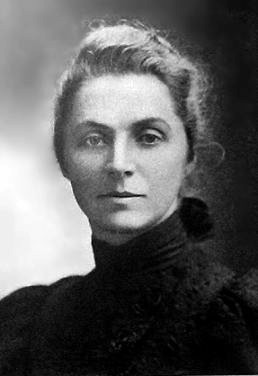
41  Emily Hobhouse: Daughter of a St Ive vicar, she became a fighter for human rights in the South African concentration camps.

42  Lord Sydney Godolphin: Lord High Treasurer, politician and diplomat described by Charles II as 'never in the way and never out of the way'.


Ann Treneer
43  Ann Treneer:  Gorran teacher and author of Schoolhouse in the Wind, much admired for her recording of Cornish dialect.

44  Joy Stevenson: St Ives writer, broadcaster and dialect expert, known as 'Maid Lowena'.

45  Silvanus Trevail: 19th century architect from Luxulyan who designed many of Cornwall's great public buildings, often for John Passmore Edwards.


Richard Carew
46  Richard Carew:  High Sheriff of Cornwall, author of the Survey of Cornwall in 1602, in which he wrote 'Cornwall as an entire state, hath at divers time enjoyed sundry titled of a kingdom, principality, duchy and earldom'.

47  Bishop Joseph Hunkin:  Mevagissey-born Bishop of Truro (d 1950).

48  Penlee Lifeboat Crew: Eight men - Trevelyan Richards, James Stephen Madron, Nigel Brockman, John Robert Blewett, Charles Greenhaugh, Kevin Smith, Barrie Torrie and Gary Lee Wallis - who gave their lives on 19 December 1981 in an attempt to save the crew of the Union Star coaster.

Fanny Moody
49  Fanny Moody:  Redruth singer known as the 'Cornish Nightingale', prima donna with the Carla Rosa Opera Company.

50  William Borlase:  Pendeen-born antiquarian and the father of Cornish archaeology during the 18th century, he was vicar of Ludgvan for 50 years and a notable opponent of John Wesley.

51  Neville Northey Burnard:  Altarnun stonemason and sculptor whose busts included Edward VII, Wesley and Thackery.  Feted by London's high society but died a pauper in Redruth.

52  Admiral Edward Boscawen:  Lord Falmouth of Tregothnan, a fearless seaman held in such high regard that when he fell out with the government, a supporter wrote: 'That shall not be.  It would put the very ocean in a storm and the large continent of Cornwall into a rebellion'.

53  Chris Blount:  Newquay broadcaster with BBC Radio Cornwall.

54  Richard Lower:  St Tudy-born fellow of the Royal College of Physicians, who performed the first successful blood transfusion before Charles II and a group of scientists in 1660.

55  Richard Nancekivell:  Rugby ace, credited for changing the course of the 1991 county championship final at Twickenham when Cornwall won.

56 Francis Bassett:  Lord de Dunstanville. Tehidy Mine owner commemorated by monument on Carn Brea.  He was a champion of the Royalist cause during the Civil War.

57  John Harris:  Minor poet and Methodist lay preacher from Troon who worked underground during the mid-19th century and penned some of the most evocative words about the life of Cornish minors, including the Dolcoath, The Mine and Carn Brea.


Ann Glanville
58  Ann Glanville:  Inspirational Saltash rower and ferry operator who travelled to France in 1850 to race, but was told on her arrival that the French crews refused to compete against her.  She would have been an asset at the Olympics!

59  Sir Humphrey Arundell:  Leader of the Prayerbook Rebellion of 1549 who, along with thousands of other Cornish, opposed the imposition of the Book of Common Prayer on the grounds that the Cornish had been accustomed to the Latin Mass and were unable to understand the English text.  Defeated at Exeter and executed.

60   Edward Pellow, Viscount Exmouth: Royal Navy Admiral liberator of slaves who sacked Algiers during the 19th century anti-slavery campaign.

http://www.thecornishstore.com/shopp388363908?c=1104851510
Great daze of Christmas*

We are charactistically out of date in our images of Christmas.  Even though there are Yule logs lying around in the parks, most of us live insmokeless zones.  We aren't going out to lug one home, even if we had a grate to burn the brute in.  Apparently we used to decorate our houses with ivy at Christmas, before the Forestry Commission made available the prunings of balding fir saplings.  And ivy goes back to the time of Bacchus.

Stage coaches, boars' heads, waits wassailing, and all the other symbols look backwards to the ghosts of Christmas Past. But future historians will note the real images of our Christmas Present*, in our brisk new Britain.

The Lights: from early autumn until the end of year they used to decorate their main streets with tasteless illuminations in honour of Snow White, Rudolph the Red-nosed Reindeer , and other tribal gods.  Ninety shopping days before Christmas some celebrity would perform the ritual of 'switching on the lights'.  A celebrity was a person whose face or other parts were recognisable because she or he had married a dim royal, taken off her shirt for page 3 or appeared on a celebrity TV programme.

The Shopping:  For these people, shopping for superfluities, rather than necessities was their inexplicable recreation.  In hellish congestion they would shuffle up and down the high streets of the cities all Saturday (no Sunday opening in those days), watching the people 'shopping', and wasting their money prodigally on useless and meretricious objects, which were sold only at this time of year, and whose purpose was often opaque or even invisible.  It has been suggested that 'shopping' was an atavistic survival of medieval ceremonies of penitence and mortification.  But in a society that worshipped material success, they enjoyed conspicuous expenditure.  And part of the attraction seems to have been that after Christmas they could do it all again, exchanging the useless objects for other equally useless items.


The Parties:  For every night of the four weeks leading up to Christmas there were at least a dozen 'Publishers' Parties'.  These ceremonies, for which no scholar has yet suggeted a plausible purpose, were notable for free-loading hordes, noise, and cheap plonk in cardboard cups, if you were lucky.  There were elements of a Mystery Religion about them, with coded messages and formulaic responses.  For example, the incantation, 'Darling, I loved your book', has been decoded as meaning.  'I never read it, but I really enjoyed the bitchy reviews'.

The Jams: As a result of these winter rituals, travelling n the centre of the towns and cities was slower than riding a centipede for the whole of December.   The roads were often blocked motionless with traffic for hours on end.  But these were people who were frightened of solitude.  They actually enjoyed sitting 'jammed' in their metal wombs, alongside millions of others, occasionally honking their horns in pleasure at being at the centre of things, 'where it was all at'.  Jam was the sticky sweet they spread of bread, and accordingly a term of approval.

The Telly:  These were deeply conservative and unimaginative people. So the national television services put on exactly the same dreadful programmes every Christmas, to relieve the public of the need to make conversation with their 'nearest and dearest' when they were marooned with them for the only time of the year.  It has been suggested that such extraordinary productions as Carry on Up the Chimney and  Wogan in the Gloaming were for penitential mortifications.  But they actually enjoyed the recycled cold cabbage.

*  Taken from a newspaper of about 1990 - have things changed since then?!!


Last month we had "National Ask Your Pharmacist Week".  Did you notice, I certainly didnt!
Most pharmacists:

  1. Dispense NHS medicines and supply a range of other medicines.
  2. Give brief advice on healthy lifie-styles including physical activity, smoking, h ealthy eating and safe alcohol use.
  3. Deliver NHS health promotion campaigns.
  4. Signpost to other healthy services and support
  5. Conduct medicines check-ups for people with long-term conditions.
Also many pharmacies also carry out:
  1. Screening and treatment for chlamydia.
  2. NHS and private stop smoking counselling.
  3. NHS minor ailments schemes (where you can obtain prescription medicines without going to your GP).
  4. NHS substance misue and harm reduction services.
  5. NHS and private emergency hormonal contraception and related sexual health support.
  6. NHS and private vascular risk assessment service.
  7. Flu vaccinations.
Some pharmacies also:
  1. Screen for hepatitis.
  2. Screen for alltergies.
  3. Prescribe medicines.
  4. Supply oral contraception on the NHS.
  5. Host of employ NHS health trainers.


1 December 2012

A few notes about Christmas:

Christmas takes a great deal of planning and time to collect, bring together, prepare, rpdouce on the day.  Christmas is rather like a pudding - a mixture.


Ginormous plum pudding on a Victorian Christmas card
Plum pudding used to comprise beef, veal, sherry, lemon, orange, cinnamon, bread, prunes, cochineal etc.  During the 1700s meat was dropped.  Lucky charms were inserted: ring - marriage; thimble - life of blessedness; money - good fortune.

The Christmas cake was introduced in the mid 1800s - like the Christmas pudding but with no meat and no alcohol.  After about 20 years, people started to decorate them, for instance with china ornaments such as father Christmas.

2nd December is St Nicholas Day: later called Santa Claus: Kingly, looked after sailors, small boys, solicitors, thievs, virgins, travellers, barrel makers, prostitues etc, later the patron saint of Russia.


There were three daughters of a solicitor who were to be forced into prostitution to pay off their father's debts.  St Nicholas climbed on the roof and dropped gold coins down the chimney, where they fell into a sock.  After that lots of people put out socks in hopeful anticipation.  St N had an elf - Black Peter - who whipped children if they'd been bad.

In stockings Father Christmas used to put - a gilt gingerbread and a toy per child, and parents used to put in other items.  

The rest of the year he rescued children from peril.  He also became patron saint of Aberdeen, after he punched a bishop (check this!).

Christmas decorations were traditionally two hoops, decorated with evergreens, apples/oranges, put in the window with a candle inside. This was called the kissing bow.

Yule log - a lit piece of wood from last year's fire, originally this was an offering to the God Thor - Church agreed it was Ok so long as it was ash as this was the fire made by the Shepherds.

Queen Victoria's ChristmasPeople tend to think that Albert the Prince Consort of Queen Victoria introduced Christmas Trees to this country.  This had been a custom in Scandinavian countries and Prince Albert merely popularised them here.  Martin Luther King had the idea of using of  decorating with fir trees when he went outside and saw all the stars in the sky and the fir trees so tall that the stars looked as though they reached all the way to heaven.  He brought in a fir tree, put candles on to represent the stars, then apples, biscuits.
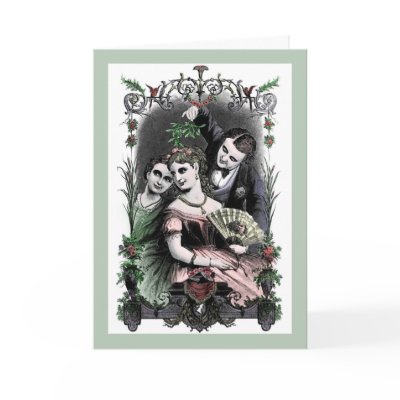
Albert and Victoria's trees were always 6' high with eight sets of branches.  On them would be gold baskets of coloured sweets, candles and ribbons.  Queen Victoria and Prince Albert had separate trees, he decorated hers (tastfully), she decorated his as she thought he would like (but did he?!).

Mistletoe is traditional at Christmas for kissing under and traditionally it was to protect people and to ensure fertility.

In many ancient religions the mistletoe was regarded as a sacred plant.  The Druids believed that a sprig of mistletoe fastened above a doorway would ward off all sorts of ills, such as witchcraft, disease, bad luck and fire.  In addition, it would enhance the hospitality - and fertility - of the household.  Hence the English Christmas custom of kissing under the mistletoe.  
But to the Norsemen the mistletoe was a baleful plant, because it caused the death of Baldur, the shining god of youth.


The traditional Service of Nine Lessons and Carols was thought up by the founder of my School, Bishop Benson, in 1880, the year my school was founded.  His son was at Oxford King's College and he introduced it to them and they popularised the tradition.

21 December was the day of St Thomas, the patron saint of old people. So they could beg/ask for money on that day for their Christmas.  (Children in Cornwall also used to beg for frumenty (hulled wheat boiled up with milk seasoned with cinnamon and sugar, from the Latin for corn).


Grandfather Frost with his fairy granddaughter
24 December is the French pere noel, Russian babouska (pink pig), United States Kristingle - a fat jolly person.  In the communist USSR he was Grandfather Frost - and his grand daughter (on 31 December) as no Christmas.


Mince Pies were crib shaped pastry, representing Christ.  They were filled with a mixture of game, rabbit, mushrooms, eggs, spices and seasoning.

Turkey is recorded as being eaten as long ago as 1520 (in Bristol), although it's by no means traditional in this country.

Crackers appeared in the 1870s, from the French idea of paper containing bonbons.  Tom Smith bought the idea back from France and by 1900 was producing over 13 million boxes a year.

Boxing Day, the day alms boxes in churches were opened, but having the day off work on that day started in Cornwall.  Gill the Draper in Truro used to give his staff the day off and the custom of not working that day spread from there.  (As a child I thought it was literally a day when boxing took place - a sort of football but, instead of a ball, a box was kicked around instead.)


Characters from late 18th century
Pantomime used to be harlequinade, scaramouche, columbine, panto clown, used to be 90% predictable with 10% of something different.  In 1772 John Rich and David Garrick of London produced one which was 10% predictable ('oh no, he isn't') and 90% different, introducing jugglers, singers, musicians, it was very popular and the idea took off.

Originally the storylines came from operas and musical plays but they soon ran out of ideas, then got scripts from made-up stories, adapting folk stories.  Music hall stars then took part, such as Marie Lloyd, through Dan Leno to Danny la Rue, pop singers in the 1960s started to make guest appearances, then soap opera start, sports celebs and even cameo spots.
Characters from the Commedia dell' Arte
The snag with panto was the scene shifting, so the idea was to have some of the action taking place in front of the curtain whilst scene changes were going on. The 1800s speciality acts were getting children in the audience on to the the stage, also offer singers, jugglers etc.  Traditional items have always been in pantos, such as the kitchen scene from Cinderella.


... and finally ...

The person whom it's all about ...


The exact ethnicity and nationality of Jesus 
(seen in the paper many years ago, so perhaps not 'pc' enough these days)

Recently, at a theological meeting in Rome, scholars had a heated debate on this subject.  One by one, they offered their evidence.  Three proofs that:

That Jesus was Italian:
He talked with his hands.
He had wine with every meal.
He used olive oil

That Jesus was black
He called everybody ‘brother’
He liked Gospel music
He couldn’t get a fair trial

That Jesus was Jewish
He went into his father’s business
He lived at home until he was 33
He was sure his mother was a virgin, and she was sure he was God

That Jesus was Californian
He didn’t cut his hair
He walked around barefoot
He started a new religion

That Jesus was Jamaican
His first name was Jesus
He was harassed by the authorities
He lived on a diet of beans

That Jesus was Irish
He didn’t get married
He was always telling stories
He loved green pastures

But perhaps the most compelling evidence is this:

That he was a woman:
He had to feed a crowd at a moment’s notice with no food
He kept trying to get the message across to men who just didn’t get it
Even when he was dead, he had to get up because there was more work for him to do