Showing posts with label christmas. Show all posts

6 January 2015

Lions given 'catnip' Christmas trees


Christmas trees are being recycled as playthings for the lions at a zoo in Cambridgeshire.
The discarded trees are 'like catnip' to the animals, said Kim Simmons, director of Linton Zoological Gardens.

Families bring their unwanted trees to the zoo so the lions can play with them and chew them, while others are used in the zoo's bio-burner to provide additional heating for the buildings.

People have been delivering individual trees and a number of nurseries have donated unsold ones.  The catnip plant, sometimes known as catmint, can cause euphoric behaviour in many cats.  'We've already had quite a few trees coming in which are giving the lions hours of fun', Miss Simmons said.

4 January 2015

When is Christmas?

There was a pertinent article in the paper on 29 December.  This was just when most people were looking forward to New Year's Eve, then spending New Year's Day recovering from the festivities: taking the Christmas Decorations down and moving on to the business of 2015.

However, Melanie McDonagh's column that day in The Daily Telegraph suggests otherwise, here's a flavour of her article:

Rejoice, Christmas has only just begun
Our festive season peaks far too early, leaving us with a long gloomy period ahead


On the fifth day of Christmas (29 December) it may be pushing it a bit to say that the festivities really don't last long enough.  Quite a few family cooks may feel that they've done their bit already, and then some.  But for many Britons, the Christmas spirit only lasts until the end of Boxing Day, even though this year the country won't fully get back into working gear until January 5.  
That's when we get all those guides in the papers about 'New Year, New You'  and the shops go into Spartan mode, with a chilling emphasis on diet and exercise products.  
We are only approaching the middle of the Christmas season, properly considered.  Because the real feast, the Christmas one, begins on Christmas Eve and goes on for 12 days - as in the carol - right through until the Epiphany, on January 6.
We shouldn't even be considering putting away the fairy lights.
Christmas should only be getting properly under way now, in a crescendo of festivity  until Twelfth Night, when the Three kings come to baby Jesus.
Certainly, that's how Christmas used to be done.  December through to Christmas Eve is Advent, or a time for preparing for the feast, which means that then we're keen to have 12 days of fun.   Today you should be winding up, not winding down.  Twelfth Night should be when the party season reaches its climax, not when we pack away the decorations.

The problem is that the secular calendar as this time of year is pretty well the opposite of the traditional way of doing things.  The office party season started at the beginning of December (or even earlier) and extends well into the New Year (we even have two 'socials' at the end of January).
The Christmas sales begin with so-called 'black Friday' (the day after Thanksgiving - an American import which we don't want, thank you!) - and so by the time we get to Christmas itself, we're partied out and up for abstinence.
It has a lot to do with the commercialisation of the season; obviously getting people into the party mood  early is a great strategy for retailers (last year I saw Christmas cards on sale on 29 July!)

to be continued ... (perhaps by next Christmas, ha ha)
http://en.wikipedia.org/wiki/Twelve_Days_of_Christmas
http://thefederalist.com/2014/12/29/lets-bring-back-the-12-days-of-christmas/
http://www.americancatholic.org/Features/Christmas/faqs.asp
http://www.telegraph.co.uk/comment/personal-view/3563809/Advent-really-does-mean-something-this-year.html

23 December 2014

The Nation's Favourite Carols

What's your favourite carol?  We Three Kings, Hark the Herald Angels Sing or even God Rest ye Merry Gentlemen?  There are so many to choose from and here are the nation's 20 favourite carols for 2014.  http://www.classicfm.com/discover/collections/christmas-music/nations-favourite-christmas-carols-2014/


If you'd like a seasonal accompaniment to your Christmas Lunch, then tune in to Classic fm at 1.00pm on Christmas Day to hear John Brunning playing this year's top 20:
http://www.classicfm.com/radio/christmas/25-december/nations-favourite-carols/?cmpid=E.Classic_OnAir_14.12.23&cmp=EMC-NEO


Some of my favourites are 

  • Oh Holy Night  (https://www.youtube.com/watch?v=q5n6X9sUznI)
  • Cowboy Carol (here's a version from my friend Richard : https://www.youtube.com/watch?v=gz9eszJfb6Y))
  • Three Kings from Persian Lands Afar (https://www.youtube.com/watch?v=RspXfkKJTvs)
  • While Shepherds Watched (alternative tune*: https://www.youtube.com/watch?v=FCifNeE1U38)

I went to school in Truro, to the Girls' High School, which was started by Bishop Benson in 1880.  There's an interesting link between Truro High School and the Festival of Nine Lessons and Carols ...
The Festival of Nine Lessons and Carols is a service of Christian worship celebrating the birth of Jesus that is traditionally followed at Christmas. The story of the fall of humanity, the promise of the Messiah, and the birth of Jesus is told in nine short Bible readings from Genesis, the prophetic books and the Gospels, interspersed with the singing of Christmas carols, hymns and choir music.
The format was based on an Order drawn up by Edward Benson, later Archbishop of Canterbury but at that time Bishop of Truro, in Cornwall, for use on Christmas Eve (24 December) 1880. Tradition says that he organized a 10:00 p.m. service on Christmas Eve in a temporary wooden structure serving as his cathedral[1] and that the purpose of the service was to keep men out of the pubs.[2]
The original liturgy has since been adapted and used by other churches all over the world. Lessons and Carols most often occur inAnglican churches. However, numerous Christian denominations have adopted this service, or a variation on this service, as part of their Christmas celebrations. In the UK, the service has become the standard format for schools' Christmas carol services.
The best-known version is broadcast annually from King's College, Cambridge, on Christmas Eve. It features carols sung by the famous Choir of King's College. Groton School of Groton, Massachusetts, has performed the festival longer than any institution other than King's, holding its first Lessons and Carols in 1928.
(from Wikipedia)

Also see 50 most loved Christmas hymns and carols:
http://www.songandpraise.org/50-most-loved-christmas-hymns-carols.htm

Index of hymns and carols:
http://www.hymnsandcarolsofchristmas.com/HTML/full_index_of_hymns_and_carols.htm
http://www.mikeleal.com/christmas/songs.html


Also: http://www.bbc.co.uk/religion/religions/christianity/christmas/carols_1.shtml

... and Christmas songs list:
http://www.allchristmaslyrics.com/list-of-christmas-songs.htm

*http://www.westbriton.co.uk/West-gallery-singers-offer-repertoire-Christmas-music-earlier-times/story-11418672-detail/story.html

8 December 2014

Some sense from John Timpson*

Why has Black Friday become such a phenomenon.  Surely this another name for a pre-Christmas sale, which will be at the expense of December sales at better margins?


You mustn't assume everything that comes from the US is good news.
Many retailers may live to regret big pre-Christmas turnover at low margins.  When I started learning our trade, a wise old retailer told me that price promotions are the lazy way to run a shop - the best shopkeepers build their reputation through a combination of quality, consistency, value and service.

It won't surprise you to discover that Black Friday failed to come to Timpson. We weren't tempted to open at midnight to resole the first 10 pairs of Church's shoes for £1, service Swiss watches at half price or even cut the price of key cutting.

In the 1960s the only shops that had a sale before Christmas were multiple tailors like John Collier.  Over 90% of their turnover came from made to measure suits with a ten-day delivery.  After 15 December they couldn't sell suits for Christmas so it made sense to start the sale.  The rest of us waited until January.

We all closed for three days over Christmas, then got ready for the sale starting on 1 January.  In the 1970s a few retailers, led by Woolworths, opened on 27 December to start their sale and gradually other shops did the same.

The Boxing Day sale was only introduced when shops were able to trade on a Bank Holiday.  Now retailers seem to be falling over themselves to cut prices well before Christmas.  They seem obsessed with the turnover figures - never mind the margin, and next year they will need to offer even bigger bargains to beat last year's turnover.


The winner is the crafty consumer,but not every bargain is what it seems.  Some retailers hold items at inflated prices in readiness for the big markdowns and buy in substandard merchandise to boost the stock available  for bargain hunters.  That cost with 70% off may have one sleeve much shorter than the other.

When the big retailers announce their like-for-like sales increases a few days after Christmas, it may be worth asking how much business has been done at a discount.

Now that Black Friday has crossed the Atlantic, retailers are stuck with it, price promotions are a disease that won't disappear.
It is very unlikely that shops will ever again enjoy the days when pre-Christmas demand brought record spending at full prices.

See:
http://www.newyorker.com/business/currency/why-were-all-so-impatient-for-black-friday
and
http://nymag.com/daily/intelligencer/2012/11/black-friday-a-behavioral-economists-nightmare.html


http://www.timpson.co.uk/about-us_meet-the-timpsons_john-timpson.php

6 September 2014

To make a quiet book to celebrate the Christmas season, here's one site which is very helpful:

http://quietbook.blogspot.co.uk/


Add caption
I love the fun element of looking underneath to see his drawers!

There are lots of ideas to make a super book.  Perhaps there could be pages which are just fun to look at with lots of detail to talk about with a toddler, like this idea:


The page above could involve counting, such as:
  1. Christmas tree
  2. Rugs/cats into front of the fire
  3. Parcels on floor
  4. Stockings hanging up
  5. Baubles on the tree

Another idea for counting could be like this as it's always nice to have a bit of fun as the reindeer slides up and down:


from: http://thesensiblehome.wordpress.com/2013/12/16/christmas-quiet-book-look-through/


http://www.pinterest.com/quietbookclub/christmas/

Christmas busy books can involve lots of subjects, things to do with Christmas itself and also to do with the winter season, such as:

*  The Nativity could show the manger, baby Jesus, Mary, Joseph, Shepherds, Wise Men, Star, animals - and angels of course.

*  The Christmas season, with parcels, stars, Christmas tree, decorations such as baubles and garlands;  stockings, Christmas puddings, roof tops, Father Christmas, sleigh, night sky, holly, ivy, mistletoe, glitter and reindeer.

*  Winter: bare trees, snow, penguins, robins, coats, mittens, boots, hats, snowballs and snowman.


and a few more ideas: https://www.google.co.uk/search?q=christmas+quiet+book&es_sm=122&source=lnms&tbm=isch&sa=X&ei=4h4fVPTjH4KsO7PggPgM&ved=0CAgQ_AUoAQ&biw=1024&bih=719

9 December 2013

Deck the halls with history

How about decorating your home for Christmas in proper period detail? (Maria Fitzpatrick, telegraph 9 December)

The pagan tradition of bringing living things inside in winter to celebrate new life and the wreath – or ‘circle of life’, was borrowed from classical imagery, and it then influenced Christian advent.  Each period of history has its decorative hallmarks, so for an authentic touch to your home this year, step back in time to Christmases past.

Tudor/Stuart: In your house with its low ceilings and dark beams, you would have celebrated the Festival of midwinter, on December 21, with boughs of holly, ivy, laurel and rosemary, which had mystical properties.  Make garlands and a ‘kissing bough’, two overlapping hoops of foliage hung from the ceiling.  Decorate with oranges, nuts, ribbons and mistletoe.  You’ll also need a decorative centrepiece for the traditional ‘drunken, gluttonous feast’, perhaps baskets of walnuts, pewter jugs, fruit and candles, taking inspiration from period paintings.  An ash ‘yule log’, wrapped in hazel twigs, should be put in the fireplace on Christmas Eve, to burn for 12 days.  If your home dates from 1644 – 1660, this will all have to be a clandestine operation as the Puriton parliament banned the trappings of Christmas.

Georgian: Celebration was allowed again after the Restoration, but the mood remained ‘modest’, especially during the age of enlightenment, when the focus was on religious ceremony.  Stick to unadorned spruce, holly, ivy and pine to highlight your staircase and fireplace and a wreath, on that handsome front door.  Use your best candlesticks, and don’t forget to display a pineapple (a symbol of propriety).

Victorian: Queen Victoria and Prince Albert releasing an image of their family around their tree, in 1848, was a key moment in terms of inspiring Christmas as we know it.  Even those in poverty would have displayed a bit of holly and ivy and hung simple paper chains.  For the rest, a tree was dressed with bags of sugared almonds, ribbons, candles and flags.  The cracker was invented, and new manufacturing methods meant glass beads and baubles, painted decorations, illustrated printed cards and intricate paper garlands to hang.  Holly is fine, but step away from the mistletoe – as an ancient fertility rite for betrothed couples, it was too suggestive for the time.

Edwardian:  This era was restrained by comparison, people would have highlighted features like picture rails, running garlands along them.  But this was also when Christmas shopping began in earnest, and the influence of window displays in department stores lent a bit of romance, with things like birds, mice and sugar plums.

Twenties and Thirties:  Pressed-metal baubles and lametta (this wine with shiny shredded metal) were the big thing in the 1920s.  In 1930, the invention of the brush-bristle tree made artificial trees popular. This was the first time the middle classes were without domestic help, some to help pick up the pine needles, so things needed to be convenient.  Many others will have lived in flats and mansion blocks, so lugging a real tree up stairs was a consideration.  These trees could take heavier ornaments so you can go to town.

Fifties and Sixties:  You can have your tinsel back (made with copper wire, it had been requisitioned for the war effort), plus a deluge of Santas, snowmen, stockings and novelty napkin rings. Europe had always led the way on Christmas tradition: now the US started to drive it forward with commercial imagery.  The biggest influence on us was their idea of using electric lights on the tree, around the room and on the outside of the house.
Children also started learning about Christmas at school and bringing home their own decorations, this added to the home made look that was being encouraged in the ideal of the Fifties housewife creating a perfect Christmas.  (I remember making lots of paper chains)

New-Build:  The decorative mood followed fashion trends, from Eighties glamour to Nineties minimalism.  Then, the wacky Noughties, with trends for upside-down trees, black trees or no tree at all.  Nowadays, anything goes, from a start Scandi-influenced paper decoration scheme to highly traditional swags and centrepieces.  Decorations are getting bigger – our average tree is now 8 ft, two years ago it was 6 ft – which might be to do with extensions and open-plan spaces.  People are using lots more lights, too.  But mostly they take a lead from their home’s architecture. 

Despite that, this year’s big theme is nature, with lots of birds, berries and greenery.  All the loud glittery stuff will be back, but when money is tight, we return to the familiar.

to be continued 

For Christmas decorating ideas go to: telegraph.co.uk/property


Concern for the environment doesn’t have to stop over the festive season

Give loved ones a green Christmas

This year has been a watershed for public concern about climate change and rising fuel bills.  Across Europe and in the traditionally more sceptical US, more than half the population accept that climate change is a serious threat, and want their governments to do more to limit carbon emissions.

In addition, the grinding years of austerity, combined with rising fuel bills mean this Christmas, a home-made or recycled gift will be joyfully received.  

That doesn’t mean you have to give everyone paperweights made from stones you picked up in a field. There is a wide range of gifts out there, from virtually free to very generous that will not use up precious resources or contribute to environmental damage. 

Vintage/reclaimed:  Buy items from bric-a-brac shops, second-hand warehouses and garage sales to improve apparently redundant items and, with a bit of sanding, waxing and imagination, turn them into usable practical homewares.  I think that’s why I call ‘upcycling’ or ‘repurposing;.

Home-made:  The extra effort of Such as scarves, pictures, patchwork cushions and jam is always appreciated.  And what about sloe gin, chutney, bags?

Adopt-a-tree:  The money donated goes towards buying and maintaining a tree.

Renewable: Gifts from renewable sources, such as wool and wood, don’t deplete the earth’s resources. 

Recycled:  Make items from unwanted and old clothes, such as bags, quilts, gloves, cushion covers.

Energy savings:  A fan to sit on top of a wood-burning stove; hand press expresso machine, wind up torch.

Esoteric:  A gift that has no physical presence at all, such as membership of a charity; a goat for Africa, a voucher and promise to have a meal together or go to a show.

 to be continued ...


Article in telegraph 9.12.13 by Sarah Lonsdale

18 November 2013

Now that it's more than half way through November it's time to start thinking about Christmas, so here are some craft projects to get us into the mood
IMG_6633

Firstly here are some crocheted stars which come courtesy of the excellent blog Attic 24 from up in the north of England:
(http://attic24.typepad.com/weblog/crochet-snowflake.html).  These stars can be made in any size using suitable yarn, so can made with any leftovers from other projects.

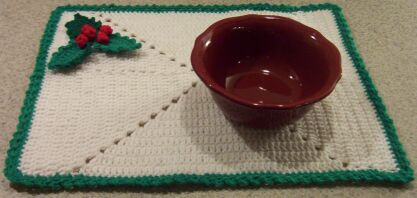
crochet Christmas holly placemat
Here's a Christmas holly place mat - or the holly part could be made separately as a decoration in its own right.  The pattern can be downloaded from this site: http://www.freecraftunlimited.com/crochet-christmas-holly-placemat.html


If a Christmas tree bauble's more  your style, here's a straightforward pattern:  http://kraftyzales.blogspot.co.uk/2010/11/how-to-crochet-christmas-tree-bauble.html


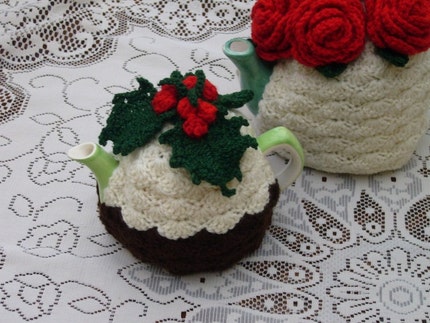
Or even a seasonal tea cosy.  Talking of which, did you know that, if left alone in a room with a tea cosy, 85% of men will try it on his head?!  I think any man will look very fetching in this number! (http://www.craftjuice.com/story.php?title=2_Cup_Crochet_Christmas_Pudding_Tea_Cosy_by_andrealesleycrochet):


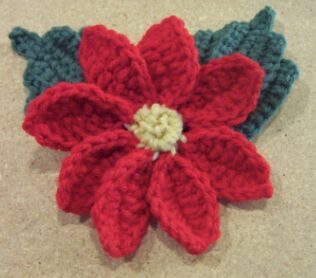
crochet Christmas pointsettia flowerAnd finally Christmas wouldn't be Christmas without a poinsettia, so here's a perpetual one, again from the site Craft Unlimited: http://www.freecraftunlimited.com/crochet-pointsettia-flower.html: