23 February 2013

Our cruise ship, capacity 1,300 people
We generally tied up at ports - so not very romantic!


There were many camels and horses near the pyramids

One of the pyramids at Giza
The pyrimids at Giza, with the Great Pyramid on the left

The great spynx
Stallholders at one of the Cairo markets

Cairo sunset - note unfinished buildings, no tax is paid until buildings are completed.  Thus so many of these properties.


at Sharm El Sheik there are many large yachts

The Red Sea at twilight - not very red.


taken from the car park

Don't go to Egypt ...
unless you can stand being harrassed ad nauseum!!

Last week, on our wonderful Red Sea cruise, we took part in an excursion to Cairo Museum* and then on to the pyramids at Giza.


The museum was wonderful and we weren't pestered at all. But out at Giza it was a very different story.

People were putting objects in our hands or on our heads, and then demanding payment.  They just would not go away. They chatted to us on any pretext, wouldn't take 'no' for an answer, and still pestered when we walked away.  Even telling them that we had no money didn't work.


It was like a recurrent nightmare.  I didn't dare take photos anywhere near them, in case they demanded payment.  So some of the photos here are taken from rather oblique angles.  That's why there are very few people, even though the place was teeming with people.  Apparently there are far fewer tourists in Egypt than is usual.  So perhaps that's why we were outnumbered by locals trying to make a living.

. Small Ear-stele, dedicated by Bai,citizen of Deir el-Medineh (lower left) to the "good ram Amun". Ears signify the god who listens to the petitioner. Limestone, 24,5 x 14 cm JE 43566 Anyway, to go back to the Museum.  There were masses of people and not nearly enough time to enjoy the 160,000 exhibits.  

We were fortunate to have an excellent guide.  As we drove through the desert from Shokran to Cairo, with evident pride in her country, she talked us through a potted history of the Eqyptian Nile area.  And when we reached the Museum itself she explained a small selection of the 160,000 exhibits.

We then enjoyed a superb buffet lunch at a wonderful hotel (no idea where or what it was called unfortunately).

Then onwards to Giza to see the famous pyramids which were very impressive, despite the desperate touts - and a definite 'once in a lifetime' experience.


graceful, smelly camels
Apart from the obvious majesty and history of the pyramids, it was evocative to see horsemen and camels, as if the time were hundreds of years ago.
Great pyramid (left)


* museum: http://www.sca-egypt.org/eng/MUS_Egyptian_Museum.htm

28 January 2013

After coming out on the other side - and not unscathed - I believe that our job as parents is to raise mature, responsible, well-rounded adults. And you typically would not get a mature well-rounded responsible adult if your daily goal was to make sure your child is happy.
Naughty teenagers at school: Parents hit with penalties if children misbehave at school
A badly behaved child probably leads to a unruly teenager

While a happy child would be nice, children need to learn how to live in a real world. They need to learn that life is demanding and hard, and definitely not always fair.

10 ways to not raise a brat:

  1. Don’t call them more than once in the morning to wake up for school - could perhaps get them to set their own alarm clock.
  2. Stop doing their laundry.
  3. Make them clean up after themselves - or confiscate their stuff.
  4. Expect them to help get dinner on the table, and to clean up afterwards.
  5. Don’t buy them a “treat” every time you go shopping, etc.
  6. Teach them how to be responsible for their own school work and make them be accountable.
  7. Don’t allow or reward whining by giving in.
  8. As often as possible, allow natural consequences to happen. Don’t intervene. These experiences can be some of the best teachers.
  9. Teach them to be independent at an early age, and continue to let them mature into further independence.
  10. While you should love your child, and let them know you are there for them as they grow, do not baby them - at age 3 or age 13. That makes for an awful 21 year old who feels entitled to everything and won’t get a job or consider moving out and being responsible for themselves.
Solution for Kid’s Messes | How to Organize your Home, Family, and Life | The Organized MomObviously this needs to be age relevant. I am not suggesting that you expect a four year old to do his laundry. However, he can learn to fix his own peanut butter sandwich, empty wastebaskets or help you sort the laundry.

Although this is think, this extract is from: http://thestressedmom.com/2012/02/how-to-not-raise-a-brat/
See also: http://thestressedmom.com/resource-center/simplifying-life/family-sized-minimalism/

26 January 2013

1759


The year 1759 should really be as well known in British history as 1066, for this was when the British finally achieved the global supremacy they would maintain for at least another hundred years.  

This is the hypothesis of  Frank McLynn in his book '1759' (Pub: Pimlico in 2005).  He goes on to say that most of the other, better-known school history dates pale into insignificance.  The Magna Carta of 1215 changed nothing; Philip II of Spain launched other armadas after 1588; and 1688 ushered in what was a very precarious 'revolution' for the first fifty years.

The famous victories of Trafalgar in 1805 and Waterloo in 1815 are justly celebrated as outstanding feats of arms, but they changed little.  Napoleon had already abandoned his invasion attempts by the time Trafalgar was fought and, even if Napoleon had won at Waterloo, he could not have prevailed ultimately against a coalition of Britain, Russia, Austria and Prussia.  

If we can trace the beginning of the British Empire to a single year, it must surely be 1759.  The defeat of the French that year paved the way for the Raj in India and made the emergence of the United States possible.

The entire history of the world would have been different but for the events of 1759.  If the French had prevailed in North America, there would have been no United States (at least in the form we know it), for it is inconceivable that France would ever had ceded any of its North American possessions and, without the Louisiana Purchase of 1803, even if we assume the thirteen British colonies had revolted successfully against the French overlords - a questionable assumption - they would have been hemmed in on the Atlantic seaboard, unable to expand westwards to the Pacific. 

If France had won in India, the global hegemony of the English language could never have happened.  Some say that the world-wide struggle for supremacy had to complete another chapter, in the Napoleonic era, before it could be assured.  

But Napoleon never looked remotely like solving the problems of seapower that prevented him from invading the British Isles.  He had no Jacobite fifth column to help him and, even if we posit the near-impossible - a successful invasion of England - the already independent United States would eventually have risen to world supremacy.  


The Louisiana Purchase (Yellow)To some extent this is a simple matter of chronology.  Napoleon's best chance for planting the French tricolour on the Tower of London came in 1805, but he had already sold the Louisiana Purchase (the vast territories on either side of the Mississippi River in what is now the south-central United States, see map) to Thomas Jefferson.

This book concentrates on the deadly duel between Britain and France in the climatic year of 1759.  I've just got this book out of the library, it looks quite fascinating and I'm looking forward to settling down to read it.  Here are a few happenings in that fateful year:


Kedleston Hall in Derbyshire was built
Handel died

Events: http://timelines.com/1759

Births: http://www.nndb.com/lists/758/000105443/ and http://en.wikipedia.org/w/index.php?search=1759+births&button=&title=Special%3ASearch

Deaths: http://en.wikipedia.org/wiki/Category:1759_deaths


When Britain was reborn

Britain in the late 1970s was a stagnant, dissatisfied place.  

Great swathes of indutry lay in the hands of the state, whose attempts to balance the demands of organised labour with economic stability had completely failed.  Inflation and unemployment were both rampant.   The government was a prisoner of the unions.  Despite the revolution of the Sixties social mores remained faintly stiff and old-fashioned.  Fashion was the pits.  

Society was divided, a fact mirrored by the absence of a meaningful centre-ground in politics, where the two main parties split beween Tory squirearchy and a Labour party whose instincts erred closed to Trotskyism than social democracy.


Then along came Mrs Thatcher.  Her improbable assumption of power in 1979, her even more unexpected retention of it in 1983 and her historic second re-election in 1987 brought about the most transformative period in British politics, culture and society since the WW2.

Thatcher's government brought monetarist economics, an aggressive foreign policy, the privatisation of industry and a commitment to shrinking the state and empowering enterprise - or as her detractors had it, encouraging greed.

Her government was as transformative as it was divisive.  Inflation was eventually tamed, but it was a ruinously painful process.  Unemployment was also controlled, after a fashion, although it was entrenched for generations in those areas of the country where heavy industry was forcibly abandoned.  


Victory in the Falklands was a tonic for the nation's self-importance, but it marked the end of Britain's ability to take unilateral military action overseas.


The sell-off of industry (and North Sea oil) certainly shrank the size of the state's broadest economic obligations, but the national budget was bloated, as is now apparent, by a permanently expanded welfare sector.  
1980s-economic-growth-inflation
Most famously, Thatcher created a generation of home owners and a booming financial sector - the two factors that probably had the greatest direct effect on national prosperity until the crash of 1007/08. 

Now, though, home owning is once again impossible for many young people, and the fact that Britain's economy is so reliant on the City seems increasingly a source of imbalance rather than strength.

So the legacy of the Eighties is still stamped on Britain, for better or worse.  To those who hated Thatcher and everything she stood for, she remains ther symbol of Tory heartlessness.  Yet politically, Thatcher's way is now effectively the ecntre ground, and has been ever since 1997 when Blair, who was Labour's Thatcher, inherited power.

All this, and more, are all described in Bang! A History of Britain in the 1980s by Graham Stewart (pub Atlantic), an accomplished, politically minded history of a decade in which Britain was painfully reborn.

23 January 2013

The 10 Best Opera Recordings


Princess Margaret once described opera as fat people shouting at each other.  Opera gets a lot of bad press, but contrary to popular belief, opera isn't that expensive, or very highfalutin, much of it, being pretty accessible.  And once you're heard a piece a few times it gradually grows on you, I assure you ...

Beethoven Fidelio
Must buy: EMI recording featuring Otto Klemperer.  Beethoven's opera is heart-stopping in the theatre but also a sublime, uplifting musical experience without that staging; not many operas convey as much of a message in 'tone' alon. Few recordings stand out as this one continues to, nearly half a century afte rit was first captured in stereo.  This recording is timeless.

Mozart Cosi fan tutte
EMI with Conductor Bernard Haitink.  Beneath its unruffled Mediterranean surface, Mozart's sublime yet cruel comedy comes to life in ernard Haitink's interpretation from Glyndebourne.

Mozart Die Zauberflote (The Magic Flute)
EMI with Otto Klemperer. The dialogue may be cut, but no collection should be without Mozart's 'opera for everybody', The Magic Flute.


Puccini Tosca
EMI with Victor de Sabata
The greatest of all Toscas, Maria Callas is captured at her legendary best, urged on by a distinguished cast and conducting of dramatic sweep.

Rossini La Cenerentola
Decca with Riccardo Chailly.  From high spirits to deep pathos, La Cenerentola (Cinderella) holds in perfect balance everything we love most about Rossini.  


Strauss Der Rosenkavalier
Decca with Erich Kleiber.  Witty yet wistful, this interpretation with the Vienna Philharmonic of Strauss's masterpiece is a classic boating a dream cast.

Tchaikovsky Eugene Onegin
Philips with Semyon Bychkov.  Russia's greatest opera, amid strong competition, this recording is the one to go for.

Verdi Don Carlos
DG with Claudio Abbado. The most epic, yet most human of Verdi's operas, DonCarlos exists in multiple versions but this (in its original French) is one of the best.

Verdi Falstaff
EMI with Herbert von Karajan.  
The richly detailed orchestration of Verdi's final opera blazes out under von Karajan's baton.


Wagner Der Ring des Nibelungen
Warner with Daniel Barenboim.  One of the greatest works of art ever conceived.


21 January 2013

Colour versus neutrals*


I can still picture myself as a youngster sitting with my mother in a large darkened cinema, watching the movies.  It was thrilling!  At the time my favourites were colourful period pieces and Hollywood musicals, and I remember thinking that the serious dramas were (and still are to a degree) always in black and white.


Films in Technicolour were invariably lively and exuberant, wherreas murder mysteries and documentary films about poverty or hard times were shot in black and white.  It's almost as if people though that colour was more frivolous than white, black and grey.

Certainly, when the fashion for minimalism was at its height, architects and interior designers would have had us living in white houses, furnished with perhaps a black leather couch and one grey painting. To be surrounded by colour was in some way undiscerning or flashy.

Padua
Personally, I find myself draw to paintings and drawings that rely on stark tonal contrasts for their impact.  I greatly admire the work of American abstract expressionists, for example, with their huge black gestural marks on white backgrounds.  But simply being excited by another artist's work doesn't mean one can or should paint like that.  
In a real sense an artist does not have that choice; one is not free to decide what one does best, which may well turn out to be different from what one imagined.  It came as a something of a surprise when I found myself painting with bright colours instead of concentrating on black and white.  Nevertheless, neutrals are important for creating atmosphere and diversity in my paintings.


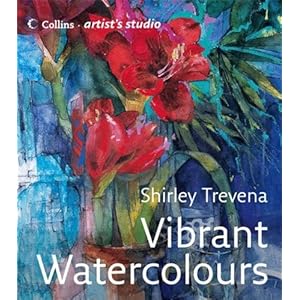
* Extract from Shirley Trevena's book Vibrant Watercolours, page 49